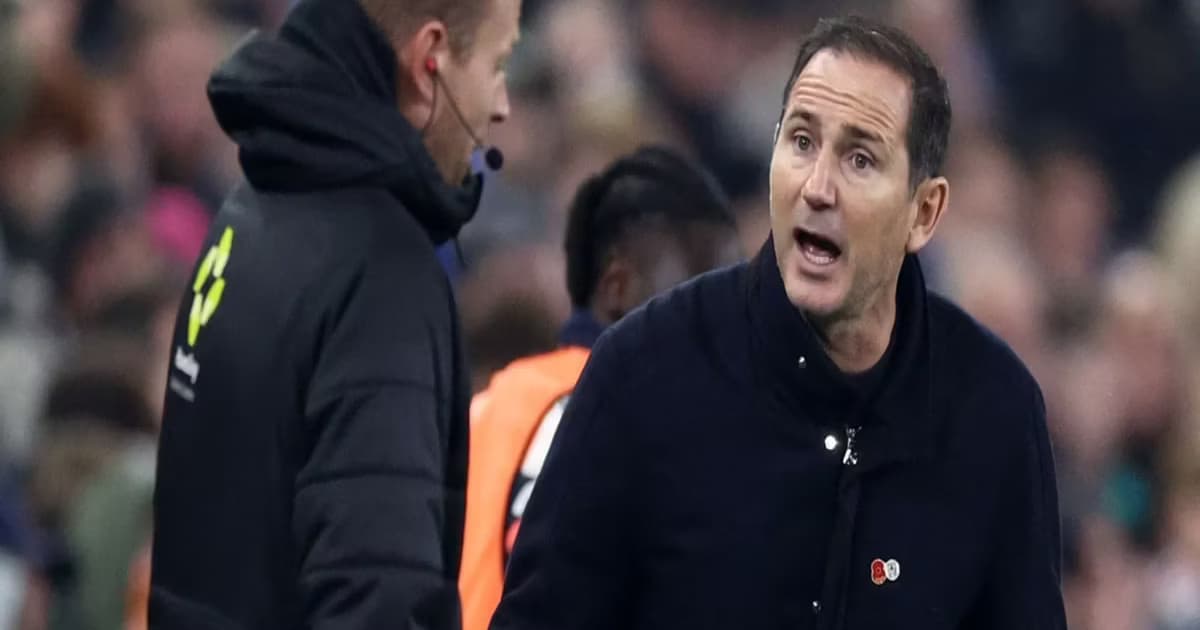

Everton's 3-1 comeback over Coventry City will be remembered for Thierno Barry's brace. That is the easy headline. The harder one is why Frank Lampard's side left Hill Dickinson Stadium convinced the match was shaped by three video reviews that all went against them.
Lampard put it without hedging after full time. "VAR is there for that and it didn't do its job," he told Sky Sports, after appeals involving a James Tarkowski hair pull, a foul on Taiwo Awoniyi near the edge of the box, and a possible handball in Barry's second goal were checked and left standing for Everton. Barry still scored twice and assisted Kiernan Dewsbury-Hall. The finishing was real. So was Coventry's greivance.
For a U.S. audience scanning Friday Night Football fallout, the useful distinction is this: Barry's night explains the scoreboard; the VAR sequence explains why Coventry feel the scoreboard is incomplete.
What the three reviews actually decided
The first flashpoint came late in the first half. Tarkowski rose to clear a Coventry free kick and appeared to pull Caleb Yirenkyi's hair while also catching Ethan Pinnock with an arm. Referee Stuart Attwell played on. VAR Timothy Wood reviewed the incident. No penalty. No card that changed the passage of play.
That call sits inside a Premier League rule change introduced for this season. Hair pulling is no longer an automatic red card; officials are told to look for excessive force or brutality before sending a player off, with a yellow available for lesser contact. Lampard accepted that it was not a red. He still argued it was a foul. "If the rule remains that it's a foul so I felt it was a foul," he said in BBC Sport's report from the ground.
Sky Sports' Jamie Redknapp called it a "definite penalty" on Friday Night Football, even while agreeing excessive force for a red was unlikely. That split — foul versus sending-off — is the part generic match reports often flatten. Last season, Tarkowski might have walked. This season, the debate shifted to whether Coventry should have had a spot-kick at all.
The second review arrived early after the break. Awoniyi drove toward the area and went down under a challenge from Vitalii Mykolenko. Attwell waved play on. VAR judged the contact outside the box, so it could not award a penalty. Lampard insisted Awoniyi's knee was "on the line of the box," which would make it a penalty under the line-is-in principle. Redknapp also called the decision "rubbish from the VAR." The camera angle level with the area, per BBC analysis, supported contact outside — a reminder that "clear and obvious" and "feels like a foul" are not the same standard.
Coventry then scored anyway. Yann Gboho finished after a deflection off Tarkowski to make it 1-0. The visitors had the lead their play deserved. They did not keep it.
Barry's brace — and the third VAR check
Four minutes after Gboho's opener, Barry equalized with a header from a Mykolenko delivery after Coventry failed to clear. Minutes later he bundled in Tyrique George's cross at the far post for 2-1. That second finish triggered the night's most forensic argument: did the ball hit Barry's hand before it crossed the line?
VAR checked again. Wood's deliberation, later aired on Sky Sports, was blunt: "Okay, that's his side, that's definitely not hand. Confirming on-field decision of goal." Lampard disagreed, saying Barry's last touch flicked it in with his hand. Co-commentator Lee Hendrie also thought it was handball. Redknapp, after watching it repeatedly, said he believed it brushed the hand but understood why VAR would not intervene without a clearer angle.
Barry himself shrugged when asked. "A goal is a goal," he said. "It's the job of the striker to score." On Everton's official site he added that he wanted to score, took his chances, and is "in good form at the moment" after reaching 10 goals in all competitions this season.
Dewsbury-Hall sealed it at 3-1 in the 81st minute from Barry's through ball — the cleanest of the three Everton goals and the one nobody disputed. Everton climbed to fifth. Coventry dropped to 16th. David Moyes equalled Harry Catterick's club record of 592 matches in charge, a landmark he called "hugely humbling" in his program notes, per The Guardian.
Why the rule change belongs in the headline
Most Friday coverage led with Barry's double, Everton's rise and Moyes' landmark. Those facts are verified and worth reporting. They are also incomplete without the officiating frame Lampard forced into the post-match narrative.
The hair-pull guidance is not a trivia note. It changed what officials are looking for, and it changed what managers can demand. Moyes, after his team moved fifth, still called the hair-pull rule "ridiculous" and said he cannot understand why it has not been fixed completely. He also denied that Barry handled the ball. Both managers, then, treated the night as an officiating story as much as a result story — from opposite sides of the same three clips.
That is the publishable differential: Everton won because Barry finished and Dewsbury-Hall closed it out, and Coventry left arguing that VAR reviewed the decisive moments and still left them without a penalty or a disallowed goal. Readers who only see "Barry brace, Everton fifth" miss the reason Lampard's press conference sounded like a refereeing brief.
The next checkpoint is whether the Premier League Match Centre offers fuller audio on the hair-pull check. Until then, the accurate frame remains narrower than a morality play and sharper than a scoreline: three reviews, zero calls for Coventry, and a comeback that will live as both Barry's night and Lampard's complaint.
By Diego Cargua — El Futbolero USA