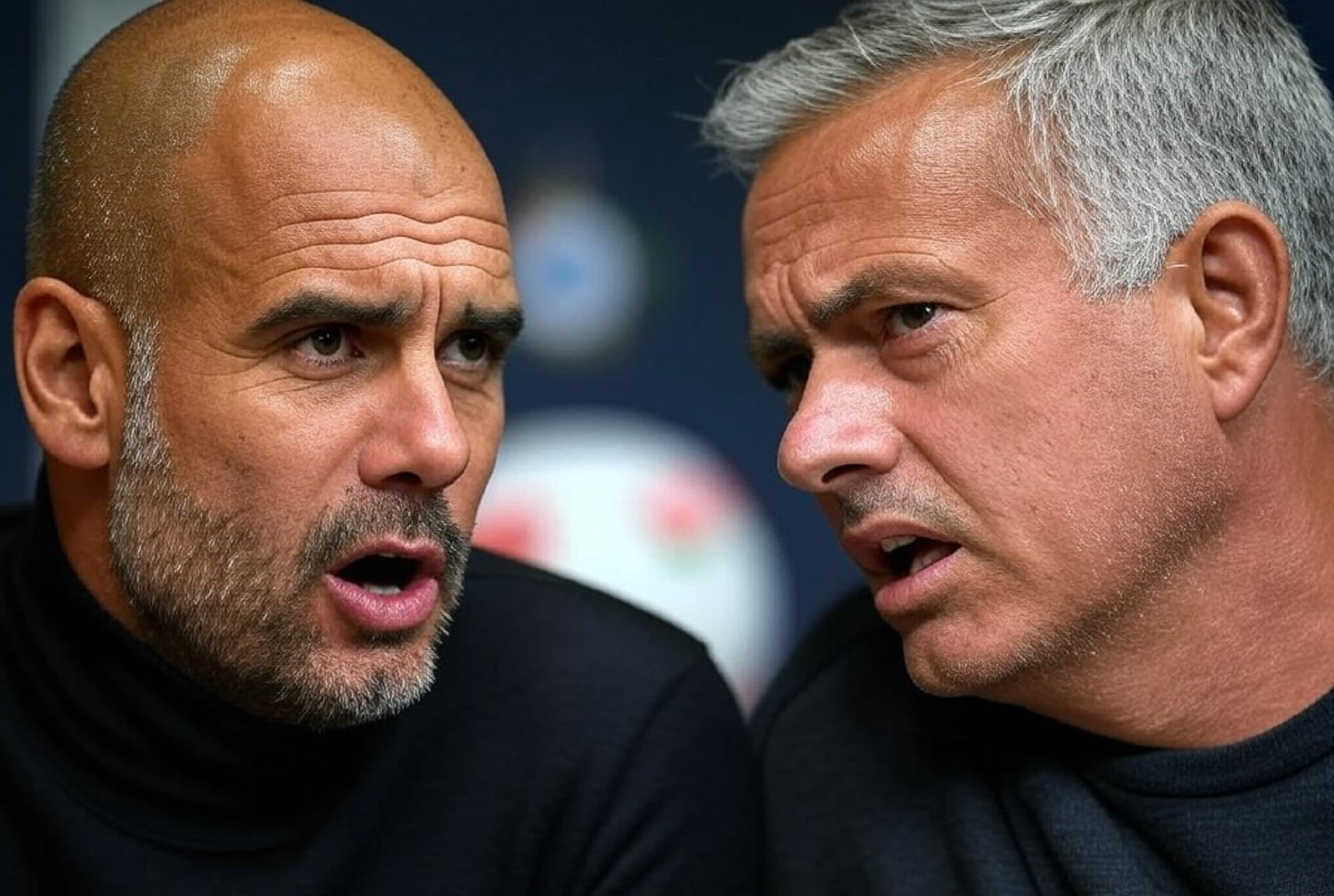

Jose Mourinho threw a new dart at Pep Guardiola and even made a challenge as he said that the day the Spaniard wins the Champions League with a team like Porto as he did in 2004, the Portuguese will retire from the bench.
The Rivalry Between José Mourinho and Pep Guardiola: A Tale of Two Football Giants
The rivalry between José Mourinho and Pep Guardiola is one of the most fascinating and talked-about sagas in modern football. These two managerial titans have dominated European football for over a decade, each with his own philosophy, style of play, and incredible success. Their paths first crossed in Spain, where they ignited a fierce competition in La Liga, and since then, their rivalry has only intensified, transcending leagues and capturing the imaginations of football fans worldwide.
The Beginnings of the Rivalry: Barcelona vs. Real Madrid
The rivalry between Mourinho and Guardiola truly began when Mourinho was appointed manager of Real Madrid in 2010, while Guardiola was in the midst of an incredibly successful tenure at Barcelona. The two managers had very different approaches to football, and this contrast set the stage for one of the most intense managerial rivalries in football history.
Guardiola’s Barcelona was the epitome of attacking football, with a philosophy rooted in possession, fluid passing, and high pressing. His team, led by Lionel Messi, Xavi, and Andrés Iniesta, became the gold standard for how the game should be played. Under Guardiola, Barcelona achieved unprecedented success, winning numerous La Liga and UEFA Champions League titles, and the team was hailed for its beautiful, almost artistic brand of football.
Mourinho, on the other hand, brought his pragmatic, counter-attacking style to Real Madrid. Known for his defensive discipline and tactical flexibility, Mourinho often employed a more direct approach, focusing on exploiting the weaknesses of opponents. His teams, while effective, were often described as more functional and less aesthetically pleasing than Guardiola’s Barcelona. However, Mourinho’s ability to outsmart and outwit his rivals made him one of the most successful managers of his generation.
The Iconic Clasicos
The stage was set for a historic rivalry when Mourinho’s Real Madrid faced Guardiola’s Barcelona in the famous El Clásico. These encounters between the two teams were more than just football matches—they were battles of tactical minds, egos, and footballing ideologies. The games were full of passion, intensity, and drama, with both managers frequently exchanging barbs in the media before and after matches.
One of the most memorable moments came in the 2010-2011 Copa del Rey final, when Real Madrid, under Mourinho, defeated Barcelona 1-0 after extra time. It was a significant victory for Mourinho, who had been under pressure to deliver silverware, especially considering Barcelona’s dominance in Spain and Europe. Despite the win, Guardiola’s Barcelona continued to dominate, winning the 2011 Champions League and La Liga titles in the same year. The competition between the two managers became a storyline that fueled the media and fans alike, with each victory adding another layer to the drama.
The Contrast in Philosophies
What made the rivalry so captivating was not only the high stakes of their encounters but also the stark contrast in their football philosophies. Guardiola, a product of Barcelona’s famed La Masia academy, was a strong proponent of tiki-taka football, a style of play based on short, precise passes and maintaining possession. His teams were built around controlling the ball, wearing down opponents, and dominating possession. Guardiola believed in the importance of technical ability and maintaining control of the game through ball retention.
Mourinho, however, was known for his tactical flexibility. He didn’t subscribe to one fixed philosophy; instead, he tailored his strategies to exploit the weaknesses of the opponent. Mourinho was less concerned with dominating possession and more focused on exploiting spaces, creating fast transitions, and being effective in both defense and attack. His teams were organized and disciplined, often sitting deep and counter-attacking with pace, especially against more possession-heavy teams like Barcelona.
These differing approaches created a contrast that made their encounters thrilling. Guardiola’s Barcelona was often at its best when it was able to dominate possession, while Mourinho’s Real Madrid was most dangerous when it could absorb pressure and hit its opponents on the counter. The clash of these two footballing ideologies was what made the rivalry so intense and captivating.
Post-La Liga Rivalry: Premier League and Beyond
After leaving Real Madrid, Mourinho’s rivalry with Guardiola continued when both managers took charge of clubs in the Premier League—Mourinho at Manchester United and Guardiola at Manchester City. The stakes remained high as both managers sought to dominate English football. Guardiola’s Manchester City, known for their attacking prowess and possession-based style, became the team to beat in the Premier League, while Mourinho’s Manchester United, though successful in some respects, struggled to match City’s dominance.
The rivalry between the two managers shifted to a new stage in England, where their contrasting styles once again became the focal point of their battles. Guardiola's Manchester City, with their quick, possession-heavy game, often outplayed Mourinho's more pragmatic, defensive setup. Guardiola’s influence on City was undeniable, leading them to multiple Premier League titles, while Mourinho, despite his successes, never quite matched City's level of dominance.
Legacy and Conclusion
The rivalry between José Mourinho and Pep Guardiola has not only shaped modern football but has also become an integral part of the sport’s history. Their contrasting football philosophies, tactical brilliance, and high-profile encounters have left an indelible mark on the game. While their rivalry has been marked by personal and tactical battles, it is their shared success that highlights their greatness as managers.
Both Mourinho and Guardiola have achieved remarkable things in their careers, and while their styles may differ, there’s no doubt that they have elevated football to new heights. Whether it was in the heat of El Clásico, on the touchline in the Premier League, or in their ongoing quest for silverware, the Mourinho-Guardiola rivalry has enriched football in ways that will be remembered for years to come.
In the end, their rivalry is a testament to the power of football, a sport that can unite and divide in equal measure, and to the genius of two managers who have shaped the modern game in their own, unique ways.